sábado, 20 de diciembre de 2008

Christmas shopping

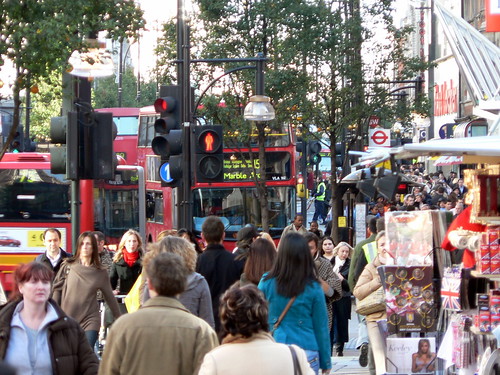
Oxford Street

By Peter Carter.


In today’s podcast, we have a serious discussion of the state of the world economy, and we go Christmas shopping with Kevin and Joanne.

As I am sure you know, there are some big problems in the world’s economy at present. There is a recession (that is, a reduction in output) in many countries, including Britain. The problem is that banks in America, and in Britain and some other countries, lent money to people who could not afford to repay. So many banks are in big trouble, and have stopped lending to anyone. So people have less money to spend, and many have lost their jobs. And the big shops are cutting their prices because they are worried that people are not buying. And governments have had to intervene, to do things, some of which are useful and some of which are not useful. That is Listen to English’s summary of the world’s economic problems. You can use it in your economics homework if you wish.

December is the biggest shopping month of the year in Britain, as it is in many countries. People want to buy Christmas presents for their friends and family, and nice things for themselves as well. As a result, the shops are full of people. But perhaps this year is different. Because of the recession, maybe the big stores and the out-of-town shopping centres are deserted. Perhaps this year, for once, it will be possible to go Christmas shopping in peace. Wrong. Things are as bad as ever.

Kevin and Joanne went Christmas shopping last Saturday afternoon. They needed to buy a present for Kevin’s aunt Joan, who is 73 years old. “A cardigan,” said Kevin. “Old ladies always like a new cardigan.” So they agreed, they would buy Aunt Joan a new cardigan.

“Good,” said Kevin. “I am glad that we have decided what to buy her. So is it alright if you buy the cardigan and I go with George to the football match”.

“No it is not alright”, said Joanne. “She is your aunt and you can come and help choose her present.”

They took the bus into the centre of town. There were crowds of people everywhere – people going to and fro; people going in and out of shops; people getting on and off buses; people getting into and out of taxis. Every now and then, there was a gap in the crowds, and Kevin and Joanne made their way carefully down the street to Marks and Spencer. Marks and Spencer is, as I am sure you know, a well-known British store which sells mainly clothes, including cardigans of the sort which 73 year old aunts like to get for Christmas.

In Marks and Spencer, Kevin and Joanne looked around for the ladies’ cardigans. They went round and round the store, and up and down the escalator, looking unsuccessfully for cardigans. Then Kevin saw them, in a corner. It took several minutes for Kevin and Joanne to fight their way through the crowds to reach the cardigans. It took about 10 more minutes to find a cardigan of the right size and colour. And it took about 15 more minutes before Kevin and Joanne reached the front of the queue at the tills to pay for the cardigan. Kevin and Joanne were exhausted. When English people are exhausted, and even when they are not exhausted, they need a cup of tea.

Kevin and Joanne looked for a cafe. They were all full. Several had a queue of people waiting outside. Then Joanne remembered that there was a cafe at the art gallery. The art gallery was empty. Perhaps people are not interested in culture at Christmas. Kevin, who had never actually been there before, looked around with interest. “That painting is upside down,” he said in a loud voice as they went through the modern art section. “And that one is sideways.” “Kevin, “ said Joanne. “The people in the art gallery know which way to hang their paintings and you don’t. Now shut up and stop making an idiot of yourself.”

There were only a few people in the cafe at the back of the gallery. Kevin and Joanne drank tea, and ate a slice of cake each. They talked about how difficult it was to do shopping when there were so many people. “You know,” said Kevin. “It is better at a football match. There aren’t as many people, and they are not so aggressive.”


Download MP3 (5:44min, 3MB)


Vocabulary Note

Look at these expressions and check in a dictionary. Then try the quiz bellow.
  • to and fro
  • in and out
  • on and off
  • now and then
  • round and round
  • up and down
  • backwards and forwards
  • from side to side
  • upside down
  • inside out
  • back to front
  • there and back
Quiz

miércoles, 17 de diciembre de 2008

Let's sing in English!

We wish you a merry Christmas


Jingle bells


Merry Christmas


Silent night


White Christmas

jueves, 4 de diciembre de 2008

Learning languages - why can't the English do it?


By Peter Carter.

I read an interesting story in the newspaper last week. It said that researchers at University College London had measured the brains of people who are bilingual (that is, people who speak two languages well) and also the brains of people who spoke only one language. They found that the part of the brain which processes information is better developed in people who are bilingual than in people who are mono-lingual. This effect is particularly strong in people who learnt a second language as a young child of less than five years old. So, quite simply, learning a second language makes your brain work better, and if you learn another language when you are very young, your brain will be very wonderful indeed!

If you are listening to this podcast, you are – I guess – learning a language which is not your own. So you must all have brains which work very well. The report in the newspaper is good news for you. Congratulations.

But it is bad news for us English, because we are really bad at learning foreign languages. Only the Americans are as bad as we are. So, British brains and American brains are perhaps not as good as the brains of people in a country like Switzerland where it is normal for people to speak two or even three languages to a high standard. In Britain, only about one adult in ten can communicate at all in a language other than English. In fact, “one in ten” may be too optimistic. A few years ago, a survey by a recruitment agency found that only 5% of British people could count to 20 in another language. What? How difficult is it to learn to count to 20 in German, or French, or Italian? British people who go to live in Spain or France are notorious for failing to learn Spanish or French, even after they have lived in the country for many years.

You probably know already that English children move from primary school to secondary school at the age of eleven. At secondary school, they start learning a foreign language, normally French. A year or two later, some children will start a second foreign language. At one time, the second foreign language was normally German, but this is not the case today. German language teaching has declined sharply in Britain. Spanish has taken its place. I do not know why Spanish has become so much more popular than German. Perhaps it is because so many English people go to Spain for their holidays.

In addition, in big cities where there is a large immigrant population, it is common for secondary schools to offer courses in south Asian languages like Punjabi or Urdu. But of course, most of the children who take these courses speak the language at home already. The courses give them a better knowledge and understanding of their own language, which is a good and important thing to do, but it does not teach them a new language.

When they are 14, children in England have to choose which subjects they will study for their General Certificate of Secondary Education (GCSE) exams, which they take when they are 16. The government decided a few years ago that it would no longer be compulsory for children to include a foreign language in the subjects they chose. The result has been that the number of children who study a language after the age of 14 has fallen dramatically. The number of children taking the GCSE French exam, for example, has fallen by 50% since 2001.

We see the same pattern when we look at British universities. The total number of students at university in Britain has risen, but the number of students taking degree courses in foreign languages has fallen. There have been particularly big declines in the numbers studying French and German.

This is not a good situation. Everyone – politicians, school teachers, academics – agree about this. If young people do not study a foreign language, probably they will not understand much about other countries or other cultures. Most British teenagers, however, do not think that learning a foreign language is interesting or important. They think that they will never need to speak a foreign language, and that all foreigners speak English anyway. Foreign languages have a low status with young people. Our government thinks that part of the answer is to start language learning at a younger age. It wants primary schools to start teaching a foreign language. However, at the same time, it has cut funding for adult education classes in foreign languages.

The problem is complicated and deep-seated. How do you think that we can interest more young people in England in learning languages?


Download MP3 (6:38min, 3MB)


martes, 25 de noviembre de 2008

Safe Schools

By Amnesty International

quote All human beings are born free and equal in dignity and rights unquote
Universal Declaration of Human Rights
First sentence of Article 1

All girls have the right to an education.This right is essential not only for girls to grow and learn, but also so that they are able to be independent and make their own choices in their lives.

Schools are not just places to learn and realize potential - some are also places of fear and violence. Some girls face violence at school at the hands of teachers, school staff or other students.

Violence stops girls going to school. Girls must be able to pursue their education in an environment which is:

  • Safe
  • Respectful
  • Non-discriminatory

Join forces in the global call for violence-free schools for girls. You have the power to make schools safe for girls!


domingo, 23 de noviembre de 2008

Glamorous dancing

By Peter Carter

I am sorry that there was no podcast last week. It was half-term week, the week in the middle of the school term when the children have a holiday. We went to Dorset, on the south coast of England, to visit my mother-in -law, so there was no time to make a podcast.

Today, I want to tell you about a TV programme which is very popular in England at present, and to introduce you to the word “celebrity”. I shall also reveal to you a secret ambition that I have!

The TV programme is called Strictly Come Dancing. It is, as you can guess, about dancing. But not any old sort of dancing. Strictly Come Dancing is about ballroom dancing. That means dances like the waltz, the quickstep and the tango – the old-fashioned sort of dancing, in other words, where men and women dance as couples, and the women wear long dresses and the men wear dinner jackets. If you still don’t understand what I mean, have a look at the Strictly Come Dancing website, where you will find lots of photos and videos.

Strictly Come Dancing is a competition. Every Saturday evening, the couples perform their dances, and a group of judges give them points out of 10. Then the viewers are able to vote by telephone for the couple they think is best. The judges’ points, and the viewers’ votes are then combined, and on Sunday evening we hear the result. The two couples with the lowest score have to dance again, and the judges decide which of them can stay and which of them has to leave the programme. It is all very exciting. My teenage daughter, and her grandmother, watch every week, along with about half the rest of the population of England.

All the people whom the BBC invites as contestants in Strictly Come Dancing are “celebrities”. “Celebrities” means people like pop singers, actors, sportsmen or women, and TV presenters. They are people you may have seen on television, in a soap opera perhaps or on a sports programme. A lot of popular culture nowdays is about “celebrities”. There are, for instance, magazines which contain nothing except news about celebrities – who is dating whom, who is getting married, who is getting divorced, what clothes they wear and which night-clubs they go to. Perhaps it is the same in your country. Clearly, celebrities leave magic lives – they are not ordinary people like you or me.

In the present series of Strictly Come Dancing, for example, there are three sports stars, two pop singers, several stars from soap operas, a TV chef and couple of models. There is also my favourite, the incomparably lovely actress Cherie Lunghi (vote for Cherie, everyone!), and a well-known television journalist called John Sergeant. John Sergeant dances like a baby elephant. The judges give him low scores, but the viewers love him, so he has stayed on the programme.

Why is Strictly Come Dancing so popular? There are several reasons, I think. It is glamorous – people love lavish costumes and beautiful music. It is about people whom we think we know. We have seen them on TV. Their faces are familiar. They have never seen us or spoken to us, of course, but we think we know them, and know what they are like. Also, Strictly Come Dancing is a competition – there are winners and losers, and we as viewers are able to vote. And finally, we all secretly think that we could dance like that too – all it needs is a bit of training and a bit of practice.

My secret ambition is to be on Strictly Come Dancing. I think I would be very good. I would dance elegantly with a beautiful lady partner and the judges would all say how wonderful I am. The viewers would think so too, and they would all vote for me. The trouble is, you need to be a celebrity to get on to Strictly Come Dancing and I am not a celebrity. How can I become a celebrity? I have looked at the job advertisements in the newspaper. There are lots of jobs for plumbers and HGV drivers, but none for celebrities, not even for “junior celebrities” or “trainee celebrities”. Maybe, just maybe, the BBC would let me on the programme as a celebrity podcaster. Perhaps if you all sent e-mails to the BBC ... Oh, never mind. It is just a dream!


Download MP3 (5:58min, 3MB)