Mostrando entradas con la etiqueta CLASS TASKS. Mostrar todas las entradas

viernes, 31 de octubre de 2008

Aesop's fables


By The Brisish Council.

The ant and the dove

An ant went to the bank of a river to quench its thirst, and being carried away by the rush of the stream, was on the point of drowning. A dove sitting on a tree overhanging the water plucked a leaf and let it fall into the stream close to her. The ant climbed onto it and floated in safety to the bank. Shortly afterwards a birdcatcher came and stood under the tree, and laid his lime-twigs for the dove, which sat in the branches. The ant, perceiving his design, stung him in the foot. In pain the birdcatcher threw down the twigs, and the noise made the dove take wing.
And the moral of the story is: 0ne good turn deserves another.

The cat and the mice

A certain house was overrun with mice. A cat, discovering this, made her way into it and began to catch and eat them one by one. Fearing for their lives, the mice kept themselves close in their holes. The cat was no longer able to get at them and perceived that she must tempt them forth by some device. For this purpose she jumped upon a peg, and suspending herself from it, pretended to be dead. One of the mice, peeping stealthily out, saw her and said, "Ah, my good madam, even though you should turn into a meal-bag, we will not come near you."
And the moral of the story is: he who is once deceived is doubly cautious.

The Crab and the Fox

A crab, forsaking the seashore, chose a neighboring green meadow as its feeding ground. A fox came across him, and being very hungry ate him up. Just as he was on the point of being eaten, the crab said, "I well deserve my fate, for what business had I on the land, when by my nature and habits I am only adapted for the sea?'
And the moral of the story is: contentment with our lot is an element of happiness.

viernes, 16 de noviembre de 2007

The Red Kite

Have a look at the story and write your opinion about it:

1. Did you like it?
2. What is it about?
4. Which country could it be?
4. What happened to the boy?
5.What is the meaning of the final sentence on screen: "War is the unfolding of miscalculation"?
6. Do you agree?

jueves, 15 de noviembre de 2007

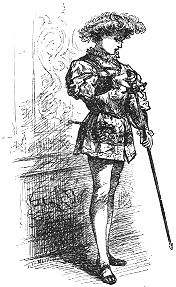
The Prince and the Pauper

Background

The plot is fictional, but you'll learn a lot about London life in the 16th century. The Prince Edward Tudor is a real character. His father, Henry VIII (the one with the six wives), died when Edward was only 9 years old, and so the child Edward became King Edward VI. Edward died at the age of 15, so he is not as famous today as his father or his sisters, Queen Mary of Scots (Bloody Mary) and Queen Elizabeth I.

Author

Mark Twain, whose real name was Samuel Langhorne Clemens, was born in Florida (Missouri) on 30 November 1835. When his father died in 1847, the 12-year old boy had to leave school and started an apprenticeship as typesetter. Aged 17, he went to New York and to Philadelphia where he wrote his first travelogues.

On 21 April 1910 Mark Twain died in Redding (Connecticut).


Excerpts: Chapters I - III
  1. The birth of the Prince and the Pauper
  2. Tom's early life
  3. Tom's meeting with the Prince
Exercises

→ Exercise on Reading Comprehension

Download

→ complete book in PDF format (704,14 KiB)

jueves, 20 de septiembre de 2007

My blog

Para crear el blog, clicamos el enlace con blogger:http://www.blogger.com/ y seguimos los pasos que nos indica. Previamente tenemos que habernos hecho una cuenta de correo en gmail.

La página que nos encontraremos es la siguiente:


Una vez que hayáis creado el blog, tendréis que decirme la dirección para añadirlo a mynameisfriday. La dirección la ponéis en comentarios de esta entrada con vuestro nombre y apellidos. Y ya podemos empezar a publicar. Lo utilizaremos para hacer redacciones, ejercicios o dictados.